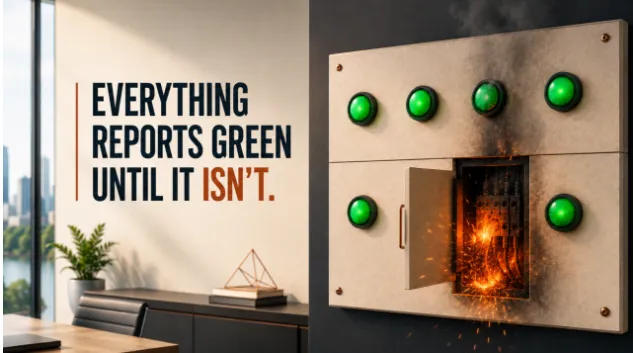
Everything Reports Green Until It Isn't
Tuesday morning, leadership meeting. The slide comes up and it’s a wall of green. Product: green. Onboarding: green. The big migration project: green, third week running. Everyone nods, the meeting moves on, and eight days later your second-largest customer calls you personally to say they’re not renewing and honestly, Sean, this has been coming for months.
Has been coming for months. Through fourteen green status reports?
Operators have a name for this: watermelon status. Green on the outside, red all the way through. And the first thing to understand about it is that nobody lied to you. That’s what makes it dangerous. If someone were lying, you could fix it with consequences. What actually happened is more ordinary and much harder to see.
Status in most founder-led companies is a feeling, not a measurement. When there’s no agreed definition of what green means, “green” translates to “I believe I can still fix this before it becomes your problem.” That’s not deception. In a loyal team, it’s practically a virtue. Your project lead genuinely believes she can recover the timeline. Your CS manager genuinely believes the relationship is salvageable. They’re not hiding the fire; they’re standing in front of it with an extinguisher, protecting you from a worry they think they can spare you. By the time they can’t, the option space has collapsed. Red arrives all at once, fully grown, with no decisions left to make except damage control.
Here’s the uncomfortable part. The more loyal the team, the slower bad news travels. Loyalty makes people absorb problems instead of transmitting them. Mercenaries escalate instantly, because covering themselves is the whole game. Your people, the ones who’ve been with you eight years and would take a pay cut before they’d disappoint you, will grind on a failing project for a month before they say the word “slipping” out loud. You built a culture where people care. The bill for that is a culture where the reporting flatters you, and you will not fix it by asking people to care more.
There’s a second layer, and it compounds the first. In most companies at this stage, status isn’t just subjective, it’s performed. The weekly meeting isn’t where leaders inspect reality; it’s where each function presents its case that things are under control. Watch the verbs in your own status meeting. “We’re tracking toward.” “We’re aligned on.” “We’re working through some challenges with.” These are not observations. They’re reassurances. A status meeting full of reassurances is theater, and everyone in the room knows it on some level, and everyone keeps performing because the founder keeps accepting the performance.
I spent years inside enterprise technology organizations where this exact failure had billion-dollar consequences, and I watched what it takes to get truthful signals out of large systems. The answer was never better people. The people were fine. The answer was changing what the reporting system asked for. Your scale is smaller. The mechanics translate almost embarrassingly well.
Three changes matter most.
First, define the colors. Not aspirationally, mechanically. Green means: on scope, on date, and no help needed. Yellow means: I see a risk to scope or date and here is what I’m doing about it. Red means: I need a decision or resources from this room. Notice what that does. Red stops being a confession of failure and becomes a request for help. You cannot overstate the difference. In a company where red means “I failed,” you will see red only after failure is undeniable. In a company where red means “I need something,” you’ll see it while there’s still time to act.
Second, replace opinion with evidence wherever you can. “How’s onboarding going?” invites a feeling. “How many customers are past their committed go-live date?” invites a number. The question determines the answer’s honesty. Most founders think they have a reporting problem when they actually have a question problem: they’re asking for status when they should be asking for observable facts. Facts don’t perform.
Third, and hardest: audit what happens to the bearer of bad news. Think about the last time someone brought you a genuine red, early, before it was obvious. What did your face do? What did your calendar do? If the answer involved visible disappointment, a flurry of check-ins, or the founder swooping in to take over, then you taught everyone in that room the real lesson, and the lesson was: never do what she just did. People don’t respond to your values statement. They respond to what they watched happen. The channel isn’t a dashboard. The channel is your reaction, and it’s the most heavily monitored signal in the company.
None of this requires new software. Founders keep buying dashboards to solve what is fundamentally an incentive problem, and the dashboards dutifully render the same subjective inputs in nicer colors. A reporting system is only as honest as the consequences for honesty.
The goal isn’t more reporting. Most companies at your stage report too much and know too little. The goal is signal you can trust, which means signal that’s defined, evidenced, and safe to send. Until you have that, every green on the wall is just a measure of how much your team hopes things will work out, and hope is the one metric that’s always green.
The renewal call still stings months later, I know. But the customer wasn’t your biggest problem. The fourteen green reports were. The customer, at least, told you the truth.