Why Execution Stalls
I’ve noticed that founders can always tell me what was agreed in Monday’s leadership meeting. Almost none can tell me what happened to it by Friday.
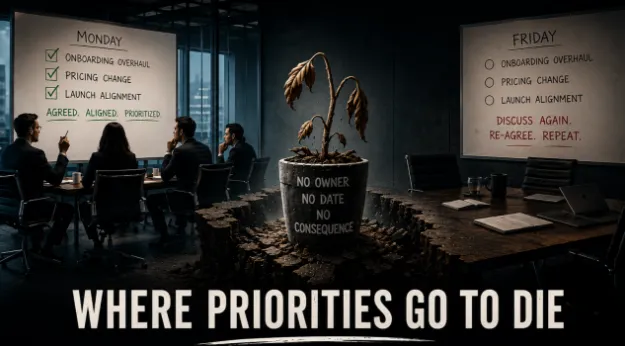
The Monday meeting is usually good. That surprises people who expect me to attack the meeting. The discussion is real, the team is engaged, and by the end there’s genuine agreement: the onboarding overhaul is the priority, the pricing change ships this quarter, marketing and product will finally get in a room about the launch. Everyone leaves aligned. Nobody is pretending.
Then the week happens.
A customer escalates Tuesday. A candidate needs an answer Wednesday. Two people are out Thursday. And the following Monday, the same items come back to the same meeting, gently rephrased, discussed again with the same sincerity, and re-agreed. I’ve read months of leadership meeting notes in founder-led companies where you could shuffle the pages into any order and never notice. Same topics, same conclusions, different dates. The meeting wasn’t a decision point. It was a weekly ritual of re-agreeing.
Priorities don’t die in meetings. They die in the gap between them, and they die of natural causes. Nobody kills a priority on purpose. It just loses every individual collision with something urgent, seven days in a row, and the meeting where it was born has no way of even noticing the death until it reconvenes.
The mechanism of death is worth examining, because founders keep trying to fix the wrong end of it. They sharpen the meeting: better agenda, tighter facilitation, a strategy offsite to really align this time. But alignment was never the problem. Your team genuinely agrees the onboarding overhaul matters. Agreement is abundant. What’s missing is the machinery that converts agreement into behavior on Tuesday afternoon when the urgent thing arrives, and that machinery has three parts. An owner. A date. A consequence.
An owner is one name, not a department. “CS and product will work on it” means the priority belongs to a conversation that hasn’t been scheduled. When something is owned by two functions, it is owned by zero people, and both sides are sincerely waiting on the other. One name, with the authority to pull in whoever they need. If you can’t say who owns it in two words, it isn’t owned.
A date is a specific day something observable will exist. Not “this quarter.” Quarter-sized commitments are where urgency goes to hide; there’s always a rational reason this week’s fire outranks a deadline eleven weeks out. The fix is decomposition: what will exist by next Friday? Something inspectable, a draft, a decision, a shipped change. Weeks are the unit of execution. Quarters are the unit of storytelling.
A consequence is the part that makes founders squirm, so let me be precise about what it means. Not punishment. Visibility. A consequence means the commitment is written down where the whole leadership team can see it, and next Monday someone will look at it, out loud, and say either “done” or “not done, here’s why, here’s the new date.” That’s all. It sounds almost too small to matter. It changes everything, because it converts a priority from a shared intention into a personal, public commitment with a clock on it. Human beings move mountains to avoid saying “not done” twice in a row in front of their peers. You don’t need a performance system. You need a visible list and the discipline to read it.
Notice what that discipline creates as a byproduct: a record. Most leadership teams at this stage have no artifact that says what was committed, by whom, for when. Everything lives in memory, and memory is a negotiator. By Friday, “we decided the pricing change ships this quarter” has softened into “we talked about pricing.” Nobody’s lying. Memory just rounds every commitment down to the nearest comfortable interpretation. A written commitment can’t be renegotiated by forgetting.
There’s one more failure hiding underneath, and it’s the founder’s own. When everything is a priority, the gap between meetings becomes a knife fight that urgency always wins. If Monday produces nine priorities, you haven’t prioritized; you’ve made a list. The unglamorous work of leadership is deciding what loses, saying it out loud, and repeating it when the losing item’s champion pushes back. A priority is only real if you can name what you’re not doing because of it. Most founders I talk to can’t, and their teams know it, which is why the team treats the priority list as weather rather than law.
I spent years running operating cadences for large technology organizations, and I can tell you the awkward secret of that work: none of it was sophisticated. Owner, date, visible review, a written record. The mechanism that keeps a 1,600-person organization pointed at the same target fits on an index card. What made it work at scale wasn’t complexity. It was that nobody was allowed to skip it, including the executive. At forty people you need the same card. You just get to run it in twenty minutes instead of two hours.
So here’s the diagnostic, and it takes one Monday. At the end of your next leadership meeting, before anyone stands up, ask: for each thing we just agreed on, who is the one owner, what exists by Friday, and where is it written down? If the room can answer in five minutes, your priorities will survive the week. If the room goes vague, you’ve just watched the exact moment where your priorities go to die, and it happens every Monday, in the last five minutes nobody uses.
Alignment isn’t the goal. Alignment is Monday. The goal is Friday.